Video gaming should be a hobby, either relaxing or competitive, in which the player is able to immerse himself or herself into a different world. But competitive gaming often prevents women and homosexuals from immersing themselves into the game because they face a constant barrage of violently sexist and homophobic remarks.
A very interesting and shocking NY Times article explores this in detail, but I'll summarize:
http://www.nytimes.com/2012/08/02/us/sexual-harassment-in-online-gaming-stirs-anger.html
The article first details the experience of a female gamer named Miranda Pakozdi who was training for a video gaming tournament, and she was the only woman on her team. Her own coach started to sexually harass her by asking what her bra size is and taunting her by getting close to her and repeatedly smelling her. Pakozdi had to drop out of the tournament.
In May, a campaign was started by a woman named Anita Sarkeesian to document the portrayal of women in video games, and she received a barrage of hateful comments and violent threats. Someone even made an internet game where you can punch Sarkeesian's face, making it turn bloody and black-and-blue.
More generally, sexual threats and propositions are common for female gamers, for many men see gaming as male territory and women as mere distractions or attention-seekers.
Female gamers have even started their own blog http://fatuglyorslutty.com/ in which women post the sexist messages they receive from other gamers. Its name derives from the tendency for people to call them "fat," "ugly," or "slutty." Some examples of messages that were posted on the blog are: "go back to the kitchen slut," "bitches shouldn't play mw3 because your fuck horrible," and "I just watched you play Halo 4... and your CHEST is awesome! Nice Halo play too."
I thought this article was interesting and relevant because video gaming is an important form of media that we haven't talked about yet -- one that is classically male-dominated but is witnessing a growing number of female gamers. The violent sexism reveals the unease of men who feel like other people are invading their territory, as if the world of online gaming belongs to heterosexual men, and to heterosexual men only.
The comments I wrote down above (that were on the fatuglyorslutty.com blog) show how even in the gaming world, women are solely valued for their appearance and are objectified by men. Their value is only seen so far as they are working in the home or kitchen, but God forbid they do something so manly as play video games! This is consistent with the heterosexual scripts outlined by Kim et. al (2007), where women are treated as sexual objects, and men are obsessed with sex and can't stop thinking about sex. This male script is evidenced by the high number of incidents where male gamers send sexually harassing messages to female gamers, in which they call attention to female appearances and body parts.
More generally, I was happy to see this article in the NY Times, because that shows that these issues are being taken seriously. Last time I checked, there were about 300 responses to the article. Many of the responses were from male gamers, and many of these responses lambasted the article for shedding a negative light on the gaming community. Many guys had the same response: "Well, that's just the way the gaming community is. If you can't handle it then don't play."
What do you guys think about that defense? Is it defensible to say that the sexually antagonizing behavior is okay because that's how the gaming community operates?
Showing posts with label Mary Hannahan. Show all posts
Wednesday, August 8, 2012
Tuesday, July 17, 2012
HBO's Big Love
I decided to give HBO's Big Love a try last year after hearing glowing praise about it from my older sister. Her tone of voice conveyed that the show wasn't good in a life-changing sort of way, but a guilty pleasure sort of way. Despite her praise, and despite the show's overwhelmingly positive critical reception, I just couldn't get into Big Love. I watched 3 episodes before deciding I disliked it. Although I couldn't quite articulate what I disliked about it at the time, since I've taken this class, I can finally put my feelings into words.
If you don't already know, the show is about a polygamous family (gasp!), which is pretty much it's only selling point. The protagonist is Bill Henrickson, who owns a large hardware store and lives in a suburban neighborhood with his 3 wives, who basically take care of the kids and bicker all day long.
Bill was initially just married to Barb (the woman to his immediate left in the picture, and who's his age). They both grew up in Mormon families but left the compounds to lead a more "normal" life. When Barb got cancer, Bill suddenly decided he wanted to by polygamous and have more wives. Barb loved him so much, so she agreed to the arrangements. So Bill married 2 more women, Nicki and Margene, who were young enough to be his daughters.
I'm not going to argue that polygamy is bad. I'm not so interested in this issue of morality, although polygamy is widely frowned upon -- which is what makes this show so seemingly interesting. No -- what I'm interested in is how HBO decided to shape these characters and represent the polygamous relationship.
They could have made strong female characters, where perhaps one of the wives was his business partner, or they could have had jobs. Instead, all three of the women stay at home and get in petty arguments. Nicki (far left in top picture), for instance, shirks all of her household chores, doesn't take care of any of the kids, and to top it off, has a spending problem. A major focus of the first 3 episodes is Nicki's shopping addiction, and how she amassed a debt of $60,000, hiding the receipts in a cardboard box under the bed. And while this is all happening, the show expects the viewer to cringe and say, 'Poor Bill! I can't believe he has to deal with all of this! He works so hard and these women just spend his money.' Margene is similarly petty. A focus in another episode is that the three women were fighting over who would be able to take the car out, since they all have to share one car. This scenario seemed to me like an argument I would have had with my sisters when I was 16. But it's true --- the women act like poorly behaving teenagers. The show has taken these three women and infantilized them.
These characters all fall into the gender roles described by Holz Ivory, Gibson, and Ivory (2009). Namely, the women show high commitment to relationship, are homemakers/unemployed, perform household tasks, and take care of children. Bill makes the decisions, works for pay outside the home, gives orders, and financially supports all three wives and their numerous children.
And then, perhaps most interestingly, there is the weird sexual dynamic between the four of them. Bill switches sleeping with a different wife every night, or every couple of nights -- something like that. So they have a Bill rotation -- to keep it fair, of course. Each woman wants Bill's full attention when it's 'her night,' and if she doesn't have his full attention, she gets jealous.
The show portrays Bill as so exhausted having to keep up with work and family life, and on top of it all, he has 3 women always wanting to have sex with him! How exhausting! Poor Bill! This is really the attitude conveyed by the show, and Bill ends up having to take Viagra since he's so exhausted he can't get aroused anymore.
This was perhaps the biggest turn off for me (pun intended). I just couldn't sympathize with Bill, or frankly, care about his emotions. The whole premise just began to seem like some stupid male fantasy -- having 3 different women always wanting to have sex. So much sex, in fact, that he couldn't handle it any more! That's when I laughed at the show and stopped watching it.
It's interesting to consider that the 2 producers of the show are men. Even more interesting is that these two male producers are also the two primary writers of the show. No wonder this show just reads like an insipid male fantasy -- it is one!
Friday, July 13, 2012
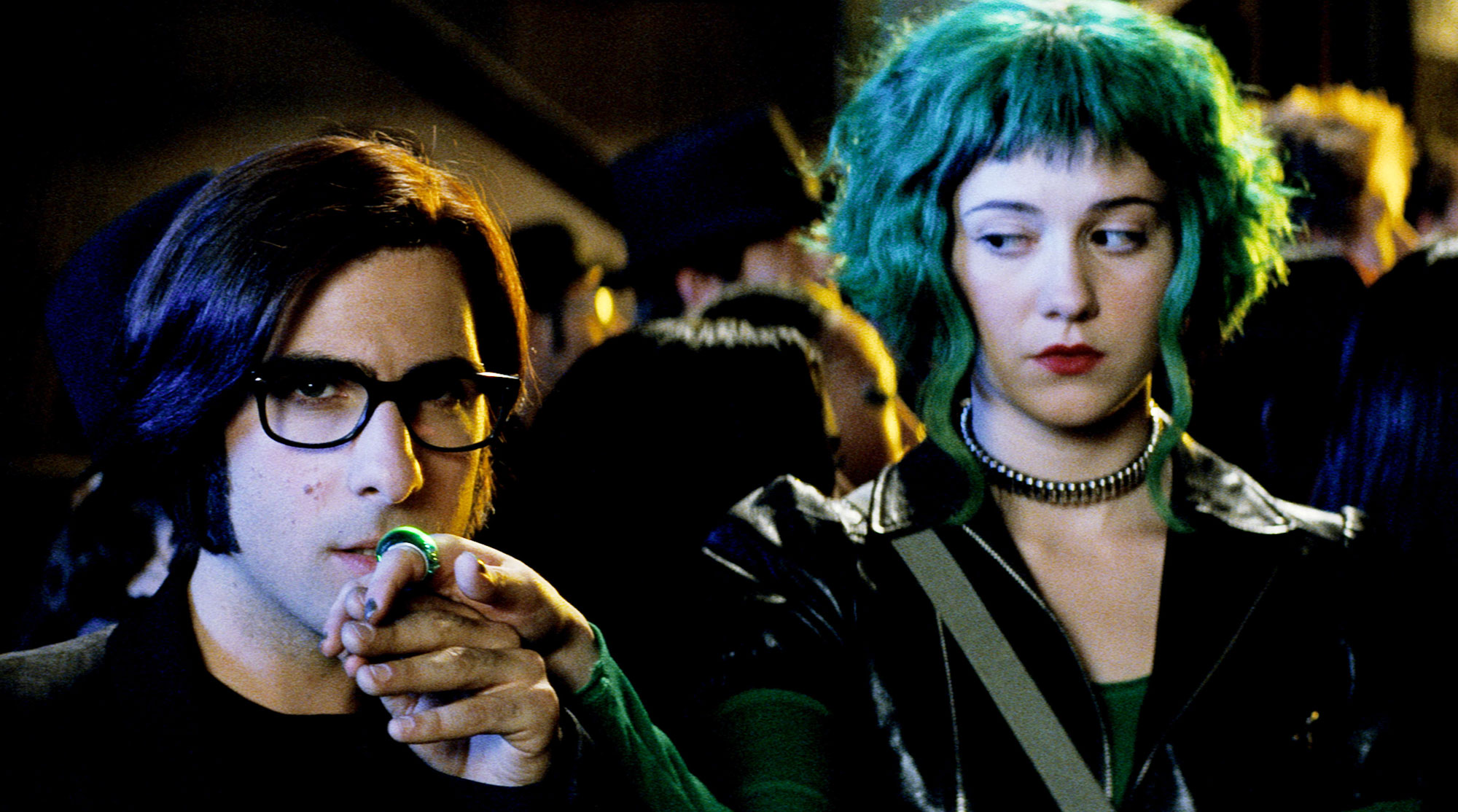
Movie Analysis: Scott Pilgrim vs. the World
Scott Pilgrim vs. the World (2010) is an atypical movie in many respects. But while the beginning of the movie contradicts some gender norms, it quickly begins to resemble a classical fairytale storyline.
The film begins with the meek 22-year-old Scott Pilgrim in an unfulfilling relationship a high school girl. He clearly wants to be in relationship, but he knows he's not with the right girl. He begins having dreams about a girl with pink hair and becomes obsessed with her. He sees her one day at a party, where he tries to talk to her who seems uninterested.
They later start going out, but Scott quickly realizes that she has baggage, in that if he wants to be with her, he has to defeat her "seven evil exes." The movie, therefore, turns into a literal video game, where Scott scores points for killing of each of her exes, hoping to secure Ramona as the final prize. Each person he fights signifies a new level, and Ramona is the end goal. Later in the movie, Ramona leaves Scott for Gideon, her final evil ex who has returned to sweep Ramona away. Gideon is old, rich, and well-connected, making him a powerful competitor that Scott needs to defeat. Throughout the movie, Scott transforms from being meek to being aggressive and powerful, and Ramona changes from being independent and powerful to being dependent and powerless.
The first scene I analyzed is when Scott and Ramona meet at a party. In typical Hollywood fashion, time slows down as the crowd parts, revealing Ramona standing alone against a wall.Scott becomes anxious and crushes the red cup in his hands in an attempt to "man up." He walks up to her, probably not as smoothly as he had envisioned, and proceeds to bore her with an awkward attempt at conversation about Pac-Man. She is stoic and unmoved by his advances, tells him to go away, and afterwards, he admits to "stalking" her for the rest of the party. After she leaves, he frantically runs around asking people what they know about Ramona. The response from each person is relatively the same: a wide-eyed look of wonder and rapture at the name Ramona, one guy saying that "she's got battle scars, dude." In other words, she has a rough past. And the overwhelming consensus among people at the party is that she's way out of Scott's league. They say Ramona is way too good for Scott -- but that doesn't deter him. He has chosen his girl, and she is powerless to stop that fate.
This scene communicates that men are supposed to actively pursue women and to be so self-assured so as to not care about how the woman feels about him. It also communicates that men should become obsessed with women without knowing anything about them (except how they look). At first glance, I thought this scene might be running counter to male dominance expectations because Scott is so awkward and bumbling, but he still ends up winning over Ramona a few minutes after this party scene. Submissive traits include being timid and meek (Holz Ivory, Gibson, & Ivory, 2009). His timidness was successful, right? With more inspection I found that it was actually his forcefulness and self-assurance that made him successful, which are dominant traits (Holz Ivory et. al). He's the one who went up to Ramona, an act that required aggression, as evidenced by when he crushed his cup in his hand. Even though she initially shrugs him off, it's Scott's self-assurance that ultimately allowed him to be undeterred by her reaction. Scott seemed to be blind to Ramona's initial lack of interest because he was so self-assured.
As for Ramona, this scene communicates that women must be passively "chosen" by men, which is consistent with female courtship strategies (Kim et. al, 2007). This scene also communicates that women are valued solely for their appearance. Again, at first I thought Ramona ran counter to this script. She's not dressed provocatively, she's not super-bubbly, and she has bright pink hair, all indicators that she doesn't care about impressing men. So on the one hand she defies the common theme in love songs that "to attract and keep a man, a woman should look like a model or a centerfold" (Bader, 2007). But Scott becomes absolutely infatuated with her solely on the basis of her appearance. Scott therefore enacts the Sex as Masculinity code in which man are supposed to "value them [women] primarily for their physical attractiveness" (Kim et. al, 2007). "Edgy" is just being used to replace "drop-dead gorgeous." I see this as just another repackaging of the same Hollywood girl. Ramona has the appearance of depth, in that she has an "edgy" appearance and a supposed "rough past". Bit this is just another superficial character sketch that leaves a female character without specific motivations, desires, or drive.
The next scene I analyzed is when Scott and Ramona hang out on their first date, and she invites him over to her house. When they meet up, it's clear that Ramona is the more powerful one in that she'll determine where the relationship will go. Scott is infatuated with her (even though he knows nothing about her), and it's up to Ramona to decide if the relationship will go further or not. When they arrive at Ramona's house, Scott starts shivering (it's snowing outside), and Ramona offers to get him a blanket from her room. After she exits the room, Scott stands up and shifts awkwardly, unsure what to do. He follows her into her bedroom, where Ramona happens to be taking off her shirt. Scott, in his typical bumbling fashion, apologizes and presses his hands over his eyes, until Ramona walks up to him, still shirtless, and kisses him. Scott suggests they get in bed, and Ramona agrees. Once they're in bed, Ramona gets slightly on top of him and then changes her mind about having sex. She says she doesn't want to do it, but that Scott can still spend the night in bed with her. She states, "I reserve my right to change my mind about the sex later." Scott looks mildly surprised, but expresses that he's genuinely happy just to lie in bed with her. He states, "This is nice, just this. It's been like a really long time, so I think I needed this -- whatever it is. So thank you."
Taken as a whole, this scene challenges gender norms because Ramona is overwhelmingly the sexual aggressor, and she calls the shots. The Heterosexual Script states that women act passively and don't prioritize "their sexual desire" (Kim et. al, 2007). Ramona counters this because she invited Scott to her house, she was the first to make a move, her physical posture dominated Scott's while they were in bed, she stopped sex from happening (without apology), and told Scott that she has the right to demand sex if she ends up wanting it. So this scene communicates that women are supposed to be in charge sexually, and that women have the right to turn down sex.
Scott's behavior mainly goes against the Heterosexual Script outlined by Kim et. al, which states men experience "sexual feelings as uncontrollable" and men are "demanding in sexual situations." Scott's only sign of masculine aggression is that he proposes getting in bed to have sex. Once they're in bed, however, he's markedly nonaggressive. He lies there motionless as Ramona climbs on top of him. He doesn't show any signs of anger that Ramona doesn't want to have sex. On the contrary, he's happy with the turn of events and even thanks her. So this scene communicates that men aren't supposed to be obsessed with sex, but rather, they should allow women to decide the terms of the relationship. It shows that a man doesn't have to be angry or devastated about not having sex.
But Scott's docile character trait doesn't last for long.
And Ramona's strength and independence don't last long, either.
The movie takes a turn for the worse, transforming into a Disney-esque fairytale, where Ramona becomes the woman in distress that needs to be saved from the evil villain Gideon.
The next scene I analyzed is when Scott fights Gideon, Ramona's seventh and final evil ex. Scott shows up at a club where Gideon and Ramona are sitting at the top of a pyramid-like platform. Gideon is holding a cane that looks like a scepter, and he and Ramona are sitting side-by-side on a bench, like an evil lord sitting with his partner on their thrones. Gideon is old (in relation to Scott), powerful, and rich. Just before coming to the bar, Scott had learned in dream that Ramona was not with Gideon by choice, but rather, Gideon has forced Ramona to be with him by implanting a computer chip in her head. So Ramona has become a pawn and the ultimate prize for her male competitors. She's literally helpless and dependent on Scott to come and save her. By the time Scott faces Gideon, he's a certifiable badass. He's become aggressive and physically dominant as he easily kills Ramona's exes, and he manages to kill Gideon without much help. As he kills Gideon and wins back Ramona, his "prize" at the end of the game, Scott and Ramona's power relations have been successfully turned upside-down.
According to Ward (1995), a common message is that males are to be regarded as "sexual competitors and females as sexual objects." Accordingly, Scott engages in a literal competition with Ramona's exes, having to kill them off. This conveys that men are supposed to fight others in order to get women, therefore treating women as the prize. The fact that Ramona appears (at first) to be attracted to Gideon is also an example of male courting strategies outlined by Kim et. al (2007), in that women are attracted to men who "exhibit wealth, power or physical strength." So this shows that the more aggressive, rich, and powerful men will win the girl.
Furthermore, this scene conveys that women are supposed to act as objects of male affection, and that ultimately a man will swoop down and save them from all of their troubles. Ramona doesn't attempt to fend for herself and is dependent on Scott, which could be coded as submissiveness (Holz Ivory, Gibson, & Ivory, 2009). She is also the object of male competition.
While the film initially challenges gender roles, the storyline topples over on its head in order to reestablish more typical power hierarchies. Ramona initially has more power in the relationship than Scott, but that changes as she becomes dependent on Scott to save her. While at first it seemed Scott could win over a girl who's "out of his league" by just being his nonaggressive, bumbling self, he eventually had to prove that he's manly enough to deserve her. Overall, the film shows that men have to be superheroes, and women have to be helplessly dependent on them.
References
Bader, A. (2007). "Love will steer the stars" and other improbable feats: media myths in popular love songs.
Critical thinking about sex, love, and romance in the mass media. Mahwah, NJ: Lawrence
Erlbaum Associates.
Holz Ivory, A., Gibson, R., & Ivory, J. D. (2009). Gendered relationships on television: portrayals of same-
sex and heterosexual couples. Mass Communication and Society, 12(2).
Kim, J. L., Sorsoli, C. L., Collins, K., Zybergold, B.A., Schooler, D., Tolman, D. L. (2007). From sex to
sexuality: exposing the heterosexual scripts on primetime network television. Journal of Sex Research,
44(2).
Ward, L. M. (1995). Talking about sex: Common themes about sexuality in the prime-time television
programs children and adolescents view most. Journal of Youth and Adolescence, 24(5).
Subscribe to:
Posts (Atom)